
Rule 4 is a deduction bookmakers take from your winnings when a horse is withdrawn from a race after you’ve placed your bet. It can apply even when your horse wins, and it often catches people out. Here’s what Rule 4 means, when it happens and why, the full deductions table, and worked examples showing exactly what it does to your bet.
Rule 4 in 30 seconds
- Rule 4 is a deduction from your winnings when a runner is withdrawn late.
- It only hits fixed-price bets struck before the withdrawal.
- The size depends on the withdrawn horse’s odds: the shorter its price, the bigger the cut.
- It’s shown as pence in the pound, from 5p up to a maximum of 90p.
- Your stake is never reduced, and losing bets aren’t affected.
What does Rule 4 mean?
Rule 4 takes its name from the rules UK bookmakers follow when settling horse racing bets. In short, it lets them reduce the winnings on a bet when another runner pulls out of the race after you’ve bet.
The deduction is quoted in pence in the pound. For example, a “Rule 4 of 25p” means 25p is taken off every £1 of your winnings. So £40 of winnings becomes £30.
Importantly, only your winnings are touched. Your stake always comes back in full on a winning bet. If your bet loses, Rule 4 makes no difference at all.
Why do bookmakers make the deduction?
When you take a fixed price, the odds reflect the whole field, including every horse you’re up against. If a runner is then withdrawn, your horse has fewer rivals. As a result, its real chance of winning goes up.
Without it, you’d keep a price that is now too generous. The bookmaker’s book would also be thrown out of balance, because the stakes on the withdrawn horse are refunded. The deduction rebalances this by trimming your winnings in line with how much the race has changed.
That’s why the withdrawn horse’s price matters so much. If a short-priced favourite comes out, the race is transformed, so the deduction is large. On the other hand, if a 50/1 outsider is withdrawn, the race barely changes, so there’s no deduction.
When does it apply?
The deduction applies when a horse becomes a non-runner after the final declarations, once a betting market has formed. Common reasons include:
- a vet’s certificate or a horse found lame on the morning of the race
- a change in the going that the trainer doesn’t like
- a horse that refuses to load into the stalls, or gets loose before the start
- a self-certificate from the trainer
It then applies to fixed-price bets struck before the horse was withdrawn. Once the bookmakers form a new market without that horse, bets placed at the new prices aren’t affected.
Starting price (SP) bets are usually safe, too. The SP is returned from the new market, so it already reflects the smaller field. The rare exception is a horse withdrawn so close to the off that there’s no time to form a new market. In that case, the deduction can apply to SP bets as well.
Ante-post bets, struck before the final declarations, don’t suffer the deduction. The trade-off is that if your own horse doesn’t run, you lose your stake, unless the bookmaker offers non-runner no bet.
Rule 4 deductions table
This is the standard table. The deduction is based on the withdrawn horse’s price at the time it was withdrawn.
| Withdrawn horse’s odds | Decimal | Deduction per £1 of winnings |
|---|---|---|
| 1/9 or shorter | 1.11 or shorter | 90p |
| 2/11 to 2/17 | 1.18 to 1.12 | 85p |
| 1/4 to 1/5 | 1.25 to 1.20 | 80p |
| 3/10 to 2/7 | 1.30 to 1.29 | 75p |
| 2/5 to 1/3 | 1.40 to 1.33 | 70p |
| 8/15 to 4/9 | 1.53 to 1.44 | 65p |
| 8/13 to 4/7 | 1.62 to 1.57 | 60p |
| 4/5 to 4/6 | 1.80 to 1.67 | 55p |
| 20/21 to 5/6 | 1.95 to 1.83 | 50p |
| Evens to 6/5 | 2.00 to 2.20 | 45p |
| 5/4 to 6/4 | 2.25 to 2.50 | 40p |
| 8/5 to 7/4 | 2.60 to 2.75 | 35p |
| 9/5 to 9/4 | 2.80 to 3.25 | 30p |
| 12/5 to 3/1 | 3.40 to 4.00 | 25p |
| 16/5 to 4/1 | 4.20 to 5.00 | 20p |
| 9/2 to 11/2 | 5.50 to 6.50 | 15p |
| 6/1 to 9/1 | 7.00 to 10.00 | 10p |
| 10/1 to 14/1 | 11.00 to 15.00 | 5p |
| Longer than 14/1 | Over 15.00 | No deduction |
Some bookmakers waive the smallest deductions, such as the 5p band, as a concession to customers. Check your bookmaker’s racing rules if you want to know exactly how they settle.
A worked example
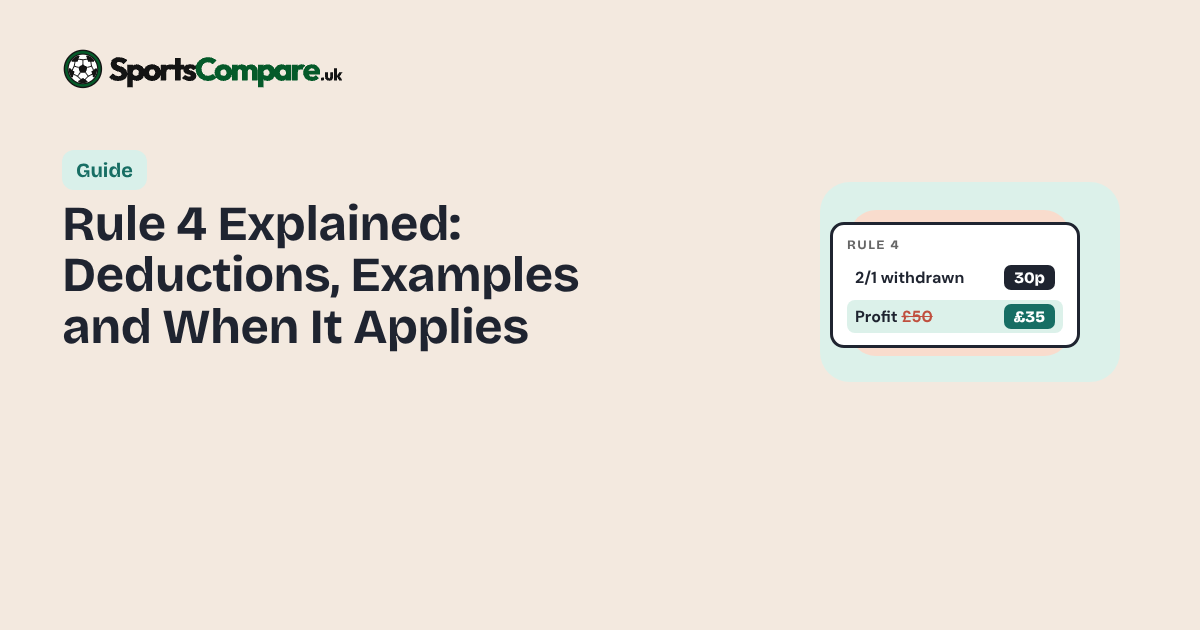
Say you back a horse for £10 at 5/1. Later that day, the 2/1 second favourite is withdrawn. According to the table, a 2/1 non-runner means a 30p in the pound deduction. Then your horse wins.
- Winnings before the deduction: £10 at 5/1 is £50 profit.
- Deduction: 30p × 50 = £15.
- Winnings after the deduction: £50 − £15 = £35.
- Total return: £35 plus your £10 stake = £45, instead of £60.
In effect, the withdrawal has shortened your 5/1 to 3.5/1, or 7/2. That’s the price a fresh market might well have offered once the second favourite had gone.
Rule 4 on each-way bets
On an each-way bet, the deduction comes off the winnings of both parts: the win part and the place part. Take £5 each-way at 10/1 in a 12-runner non-handicap, paying three places at 1/5 of the odds. A 9/2 runner is withdrawn, so the deduction is 15p.
| Result | Normal return | Return after a 15p deduction | Profit on £10 |
|---|---|---|---|
| Wins | £70.00 | £61.00 | +£51.00 |
| 2nd or 3rd | £15.00 | £13.50 | +£3.50 |
| Unplaced | £0 | £0 | −£10.00 |
If your horse wins, the £50 win profit drops to £42.50 and the £10 place profit drops to £8.50. If it only places, you get the £8.50 place profit plus your £5 place stake.
Withdrawals can also change the place terms. Bookmakers settle on the runners that actually start, so an eight-runner race that drops to seven pays two places instead of three. Our each-way betting guide explains place terms in full. Alternatively, the each-way calculator has a Rule 4 option that does the maths for you.
What if more than one horse is withdrawn?
Each withdrawal brings its own deduction, and they’re added together. For instance, if an 11/2 runner (15p) and a 12/1 runner (5p) both come out, the total deduction is 20p in the pound. However, the combined deduction can never be more than 90p.
If a second horse is withdrawn after a new market has formed, it gets more complicated. Bets struck in the first market are usually deducted for both horses, while bets in the new market only bear the second deduction.
How to limit the impact
You can’t avoid it entirely if you like to take early prices. Still, a few habits help:
- Check the non-runners first. Bookmakers and racing sites list them. A horse with a doubt over the going is a likely withdrawal.
- Bet after a new market forms. If a fancied horse comes out, the new prices already allow for it.
- Use best odds guaranteed. With best odds guaranteed, you’re paid at SP if it beats your price. Bookmakers handle Rule 4 under BOG in different ways, so read their terms.
- Read the result. Results pages show any deduction and the reason, so you can check your settlement is right.
Free bets and non-runners
The rule applies to bets placed with free bets in the same way. Since a free bet stake isn’t returned, the deduction simply comes off the winnings you keep. Our guide to how free bets work covers the basics. Meanwhile, if you’re looking for a racing-friendly sign-up offer, here are some of the simplest to claim right now:
Free bet offers

Paddy Power Sports Easy Low risk
£30 in free bets
18+ · Code YSKAST · £5 bet at evens+ · £30 free bets · 30 days · Debit/Apple Pay/bank
Full T&Cs
18+ · New Customer offer - Use promo code YSKAST. Place a min £5 bet on the sportsbook at odds of min EVS (2.0) and get £30 in free bets. Free bet rewards valid for 30 days. Only deposits via Pay by Bank, Debit Cards & Apple Pay will qualify for this offer. T&Cs apply. Please Gamble Responsibly

Kwiff Sports Easy Very low risk
£40 in free bets
18+ · £10 bet at 2.0+ in 5 days · 4 x £10 free bets (3+ legs each) · 7-day expiry
Full T&Cs
New UK customers. £10 cash bet, min. odds 2.0, in 5 days of deposit. Get 4x £10 Free Bets: Single, 2 Accas & Bet Builder (3+ legs each). Excl. cashout, E/W, Multis, Ineligible Markets & Odds Boosts. 7-day expiry. T&Cs apply. 18+ | GambleAware

Unibet Sports Easy Very low risk
£40 in free bets
18+ · Opt in · Dep & bet £20 at 2.0+ in 7 days · £40 free bets · 7 days · Debit/bank only
Full T&Cs
18+ | GambleAware.org. New GB customers only. Opt in, deposit and Bet £20+ on sports at min odds of 2.0+ (1/1) for £40 in Free Bets within 7 days of registration. Debit cards or instant bank transfers only. Free bets expire within 7 days of issue. Geographical restrictions and T&C’s apply.
No offers match those filters — try clearing one.
Compare every free bet offer →
Rule 4 FAQ
No. Rule 4 is only ever taken from your winnings. On a winning bet your stake is always returned in full, and on a losing bet the deduction makes no difference. It means 10p is taken off every £1 of winnings, which is a 10% cut. So a bet with £80 of winnings would pay £72 in winnings, plus your stake. Usually not. SP is returned from the new market formed after a withdrawal, so it already reflects the smaller field. The exception is a horse withdrawn so late that no new market can be formed. 90p in the pound. That applies when the withdrawn horse was 1/9 or shorter, and it is also the cap when several horses are withdrawn from the same race. Yes. The deduction comes off the winnings of both the win part and the place part of an each-way bet. Yes. It comes off the winnings in the same way. Because free bet stakes aren’t returned, the reduced winnings are all you receive.Does Rule 4 come off my stake?
What does a Rule 4 of 10p mean?
Does Rule 4 apply to starting price bets?
What is the maximum deduction?
Does Rule 4 apply to each-way bets?
Does it apply to free bets?
18+ only. Free bets and welcome offers are for new customers and T&Cs apply. Please gamble responsibly and only bet what you can afford to lose. If gambling stops being fun, visit our responsible gambling page or call the National Gambling Helpline on 0808 8020 133. Free advice is also available from BeGambleAware.org.